← Back to home

Nearshoring · 2026-08-13

The Bajío's Auto Corridor: North America's Engine for Electric Mobility

Querétaro, Guanajuato, San Luis Potosí and Aguascalientes logged 44 automotive projects worth $507 million in the first half of 2026. Why the Bajío is now Mexico's most contested industrial corridor — and what the USMCA review means for its future.
The Bajío's Auto Corridor: North America's Engine for Electric Mobility

Mexico's Bajío region — the industrial corridor spanning Querétaro, Guanajuato, San Luis Potosí and Aguascalientes — has outgrown its old identity as the country's central manufacturing belt to become the epicenter of North America's automotive transition. Between supply chain relocation, incoming Asian and European capital, and the global race toward electric mobility, the region is living through one of the most intense industrial investment cycles in its recent history. That boom, however, is unfolding alongside a variable that could rewrite the rules of the game: the USMCA review, scheduled for July 2026.

1. Mexico's most dynamic industrial corridor

  • —Growing inventory: by the close of Q1 2025, the Bajío's industrial inventory reached 14.4 million square meters, up 4% year over year, with Querétaro and Guanajuato capturing most of the new supply.
  • —Historically low vacancy: the availability rate closed at 3.5% in Q1 2025, down 1.10 percentage points year over year. By July 2026, available supply held steady around 1 million square meters.
  • —Net absorption: the Bajío posted 88,118 square meters of net absorption in Q1 2025, with Guanajuato leading regional gross demand at 46% of the total, driven by diverse manufacturing transactions.
  • —Rental rates: Querétaro remains the priciest submarket at $6.03 per square meter per month, followed by San Luis Potosí ($5.63) and Guanajuato ($5.19) — levels still below the national average.

2. The automotive-EV push: $507 million in six months

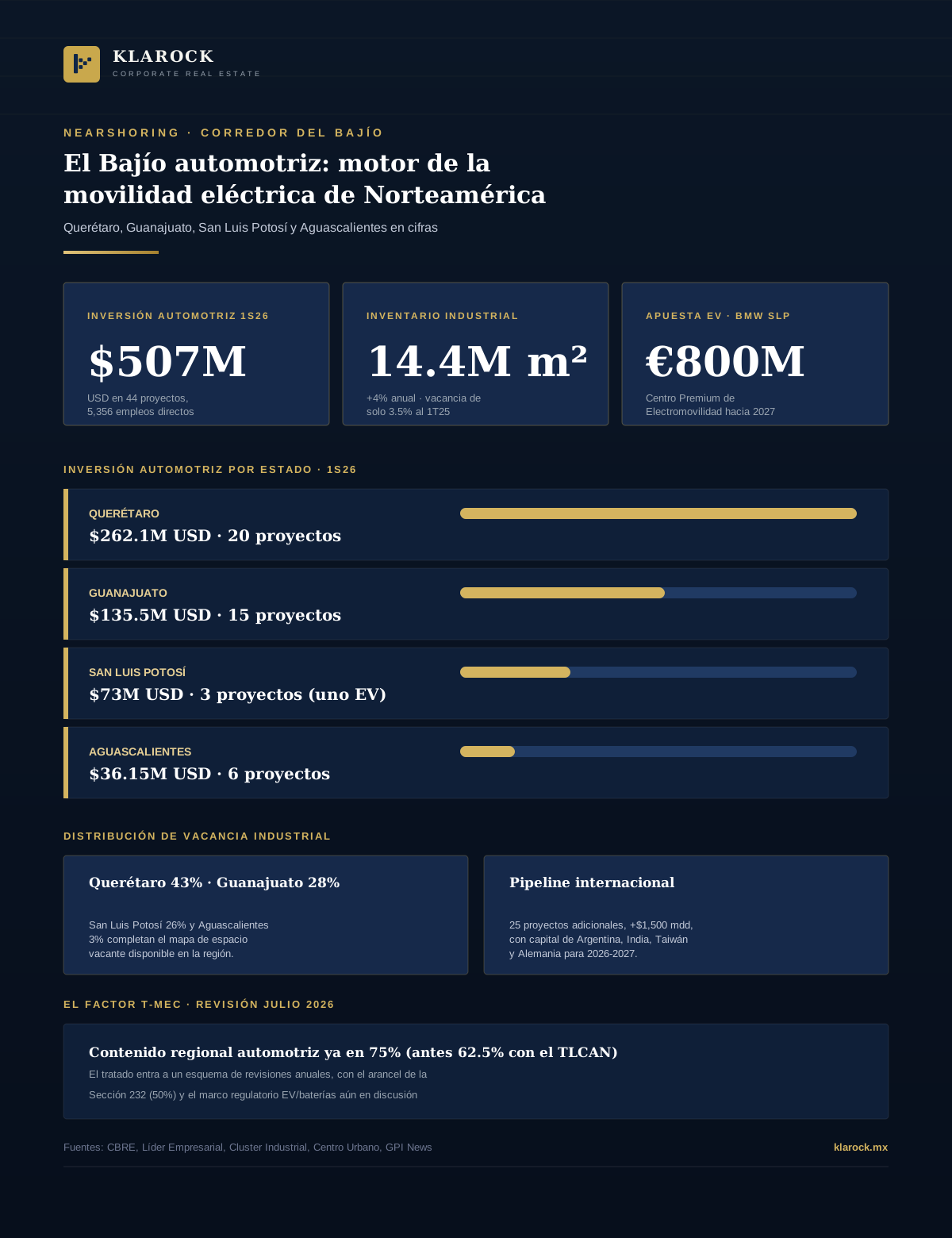
  • —44 projects, four states: during the first half of 2026, Querétaro, Guanajuato, San Luis Potosí and Aguascalientes together logged 44 automotive projects worth $506.75 million, projected to create 5,356 direct jobs and 358,420 square meters of construction.
  • —Querétaro out front: the state captured $262.1 million across 20 projects, cementing its role as the region's biggest draw.
  • —Guanajuato, the second engine: with $135.5 million across 15 investments, the state reinforces its long-standing identity as the Bajío's automotive cluster.
  • —San Luis Potosí and Aguascalientes: San Luis Potosí added $73 million across three productive projects focused on the auto-parts supply chain, one of them dedicated to EV components; Aguascalientes contributed $36.15 million across six projects.

3. BMW and the bet on premium electromobility

The most visible sign of the shift toward electric mobility is unfolding in San Luis Potosí, where BMW is investing 800 million euros to expand its plant to build vehicles on the Neue Klasse platform, alongside high-voltage battery production. The project will turn the San Luis Potosí plant into a Premium Electromobility Center by 2027 — proof that the Bajío is no longer competing solely for traditional assembly work, but for manufacturing the critical components of the next automotive generation.

4. The USMCA factor: the variable that could redefine the region

  • —Review set for July 2026: the United States opted not to automatically renew the treaty for another 16 years, pushing USMCA toward an annual review scheme that introduces medium-term regulatory uncertainty.
  • —Tighter rules of origin: automotive regional content requirements already rose to 75%, up from the 62.5% required under the old NAFTA, and U.S. negotiators are also seeking to revisit labor-compliance mechanisms and steel-sourcing rules.
  • —Tariffs and the EV framework under discussion: disagreements persist over the 50% Section 232 tariff, while Washington is also pushing to review the regulatory framework for electric vehicles, hybrids and new battery technologies.
  • —Employment holding steady: despite the uncertainty, Guanajuato ranked fifth nationally for monthly formal-employment growth in June 2026, with 1.13 million workers registered with IMSS and an annual increase of 6,946 jobs.

5. What it means for industrial real estate

The Bajío's vacant industrial space is unevenly distributed: Querétaro holds 43% of the region's vacant industrial surface, Guanajuato 28%, San Luis Potosí 26%, and Aguascalientes the remaining 3% — a snapshot that shows where negotiating leverage still exists and where competition for space is already intense. Layered on top of that base is a pipeline of 25 additional projects worth more than $1.5 billion, backed by capital from Argentina, India, Taiwan and Germany for 2026-2027 — a signal that the diversification of capital origin will keep intensifying demand for specialized industrial land.

For developers and investors, the Bajío's automotive story can no longer be read in square meters alone: how the USMCA review resolves, the pace of plant electrification, and the availability of skilled labor will, over the next 24 months, matter as much as a site's location itself. At Klarock we closely track this dynamic to advise every expansion or investment decision in Mexico's most contested industrial corridor with real data.

Interested in this opportunity?

Reach out and a managing partner will contact you within 24 business hours.

Contact a Managing Partner