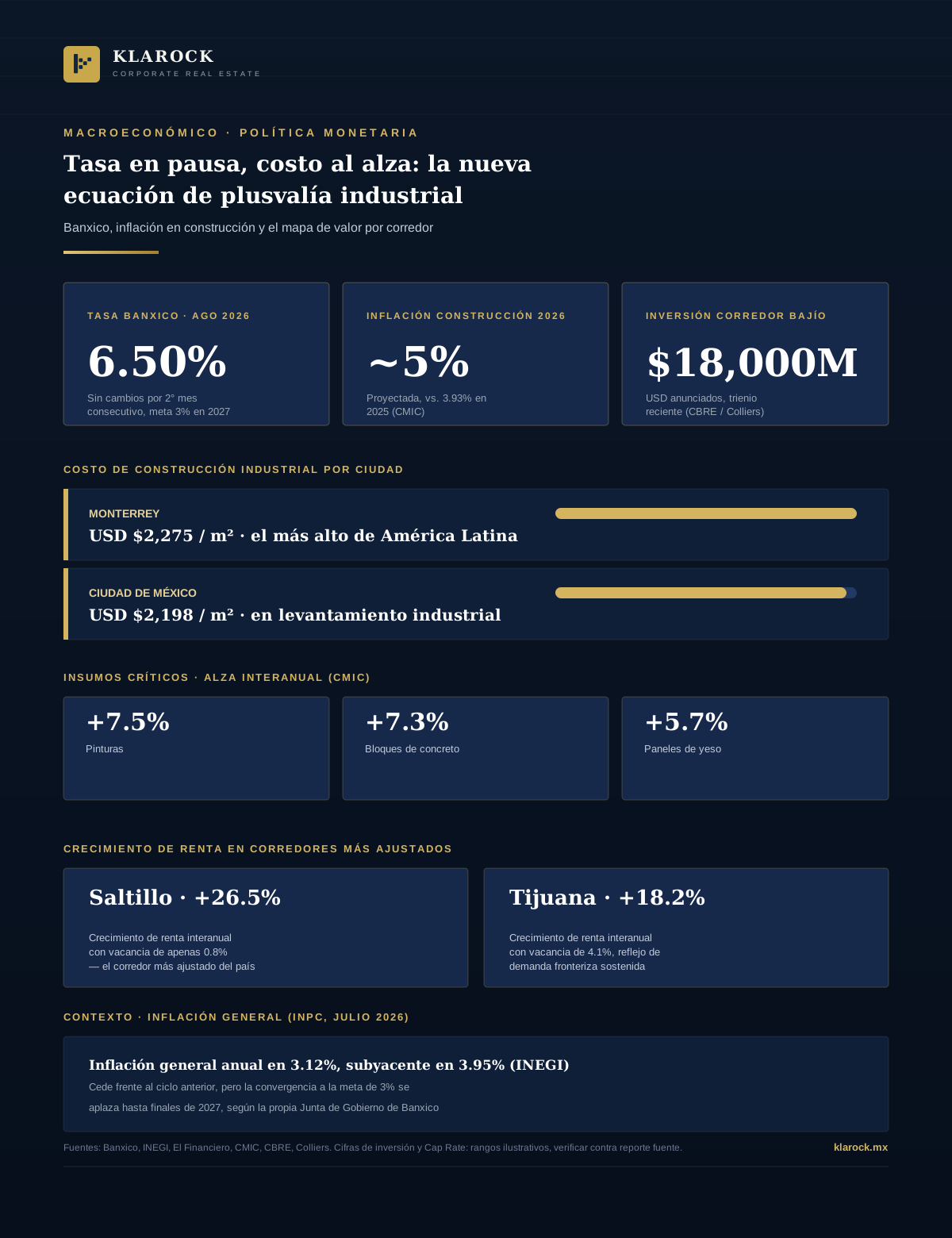
On August 6, 2026, Banco de México's Governing Board decided, unanimously and for the second consecutive time, to hold the overnight interbank rate target at 6.50%. The decision extends the pause that began after May's cut and pushes the expectation of inflation converging to the 3% target out to late 2027. For an institutional investor, the immediate read —financing certainty— is only half the story: while the rate is frozen, the cost of building new inventory keeps climbing, and that asymmetry is what is reshaping Mexico's industrial and corporate cap-value map.
1. Monetary Policy: Certainty Without Full Relief
- —Extended pause: Banxico held the rate at 6.50% in its August 6, 2026 announcement, unchanged since May's cut (from 6.75% to 6.50%), and expects it to remain at that level for the rest of the year.
- —Headline inflation easing: July 2026's INPC (INEGI) put annual headline inflation at 3.12%, with core inflation at 3.95% —an improvement over the prior cycle's peaks, though still above the central bank's point target.
- —Convergence pushed back: the Governing Board itself acknowledged the 3% inflation target won't be reached until late 2027, implying an elevated and stable —not declining— reference rate through most of the medium-term investment horizon.
2. The Other Inflation: The Cost of Building
- —Mexico, the region's most expensive: per El Financiero (Aug 3, 2026), Mexico is now the most expensive country in Latin America to build in, with Monterrey at US$2,275 per square meter and Mexico City at US$2,198 per square meter for new industrial construction.
- —Critical inputs rising fast: per the Mexican Chamber of the Construction Industry (CMIC), over the past year paint prices rose 7.5%, concrete blocks 7.3%, and gypsum panels 5.7% —well above headline inflation.
- —Pressure building into 2026: industry specialists project construction-sector inflation approaching 5% in 2026, up from 3.93% at the close of 2025, driven by the reactivation of housing production and the impact of US tariffs on imported inputs.
3. The Combined Effect: Less New Supply, More Pressure on Existing Stock
- —Nearshoring demand isn't slowing: the Bajío corridor (Querétaro, Guanajuato, Aguascalientes and San Luis Potosí) has attracted more than US$18 billion in announced investment over the recent three-year period, per tracking from CBRE and Colliers.
- —The tightest corridors already show it in rent: Saltillo posted 26.5% year-over-year rent growth at just 0.8% vacancy, and Tijuana grew 18.2% year-over-year at 4.1% vacancy —evidence that the higher replacement cost is already passing through to lease rates in the most contested submarkets.
- —Absorption confirms structural demand: after a moderation cycle —from 5.7 million sq m of national net absorption in 2022 to 4.4 million in 2024—, Mexico City closed 2025 with a record 1.6 million sq m of gross absorption, a sign the slowdown is one of pace, not substance.
4. The Read for the Institutional Investor
The combination of an anchored reference rate —financing certainty well into 2027— and a replacement cost rising above headline inflation directly favors the asset that is already built, and the site with the location, infrastructure and permits to build today before cost climbs another point. In corridors where nearshoring keeps absorbing space faster than new supply can match it, that gap between demand and replacement cost has historically been the most reliable engine of cap-value appreciation.
At Klarock we translate these macroeconomic indicators into portfolio decisions, tracking rate, construction cost and cap-value appreciation by corridor for every expansion, relocation or investment decision in Mexico.