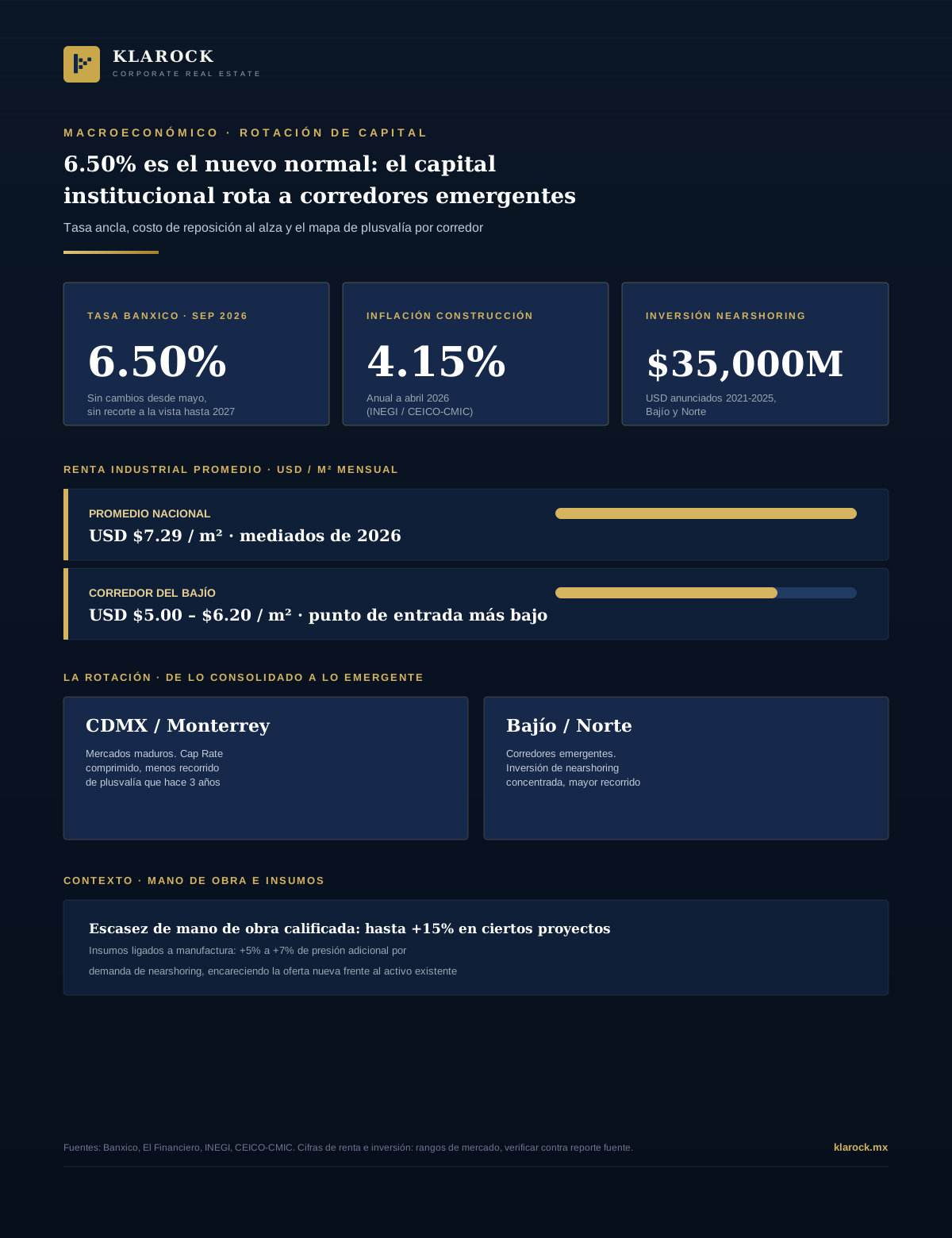
Banco de México ended its cutting cycle on May 7, 2026, taking the reference rate to 6.50%, and has held it unchanged at every subsequent announcement since. Market analysts no longer treat it as a moving variable: most don't expect another cut before 2027. For institutional capital, that certainty stopped being news weeks ago. The conversation that matters now isn't when Banxico moves next —it's which corridor in the country still has cap-value appreciation left to capture before the cost of building new inventory closes that window.
1. The Rate Stopped Being the Story
- —Cutting cycle concluded: Banxico took its target rate to 6.50% on May 7, 2026 and has held it at every decision since, per El Financiero's coverage of the central bank's monetary policy announcements.
- —No new cuts in sight: analyst consensus places the probability of the next downward move as late as 2027, making 6.50% the working assumption for modeling cost of capital on any project breaking ground today.
- —Certainty already priced in: with financing stabilized, the spread that used to explain where to enter a market is no longer the rate —it's replacement cost and the cap-value appreciation still available by corridor.
2. Replacement Cost Hasn't Stopped Climbing
- —Construction inflation at 4.15%: INEGI's construction-sector price index put the annual variation at 4.15% as of April 2026, above headline inflation, with residential housing at 4.63% per CEICO-CMIC tracking.
- —Skilled labor, the real bottleneck: the shortage of specialized workers has pushed certain project costs up by as much as 15%, while manufacturing-linked inputs face additional pressure of 5% to 7% driven by nearshoring demand.
- —Direct effect on new supply: every point of construction inflation delays new Class A+ inventory coming online and makes greenfield development more expensive relative to already-built assets or entitled land ready to build.
3. The Rotation: From Mature to Emerging
- —Mature markets already compressed their Cap Rate: in consolidated submarkets of Mexico City and Monterrey, entry price per square meter and Cap Rate compression leave less room for appreciation than three years ago.
- —The Bajío is capturing the new investment: between 2021 and 2025, Mexico attracted more than US$35 billion in announced investment linked to nearshoring, heavily concentrated in the industrial corridors of the Bajío —Querétaro, Guanajuato, Aguascalientes and San Luis Potosí— and the North.
- —The entry point is still low: average industrial rent in the Bajío corridor sits between US$5.00 and $6.20 per square meter monthly, below the national average of US$7.29 per square meter recorded in mid-2026 —the gap that underpins the case for greater cap-value appreciation ahead.
4. The Read for the Institutional Investor
With the rate anchored and no monetary policy surprises on the immediate horizon, the return spread is no longer explained by the cost of credit, but by the gap between what it costs to replace inventory and what can still be paid to enter a corridor. That gap is wider in the Bajío and the North than in consolidated submarkets, and it keeps narrowing as construction cost presses down on new supply. The window doesn't close all at once —but every quarter that passes, it closes a little more.
At Klarock we translate these macroeconomic indicators into portfolio decisions, tracking rate, construction cost and cap-value appreciation by corridor for every expansion, relocation or investment decision in Mexico.