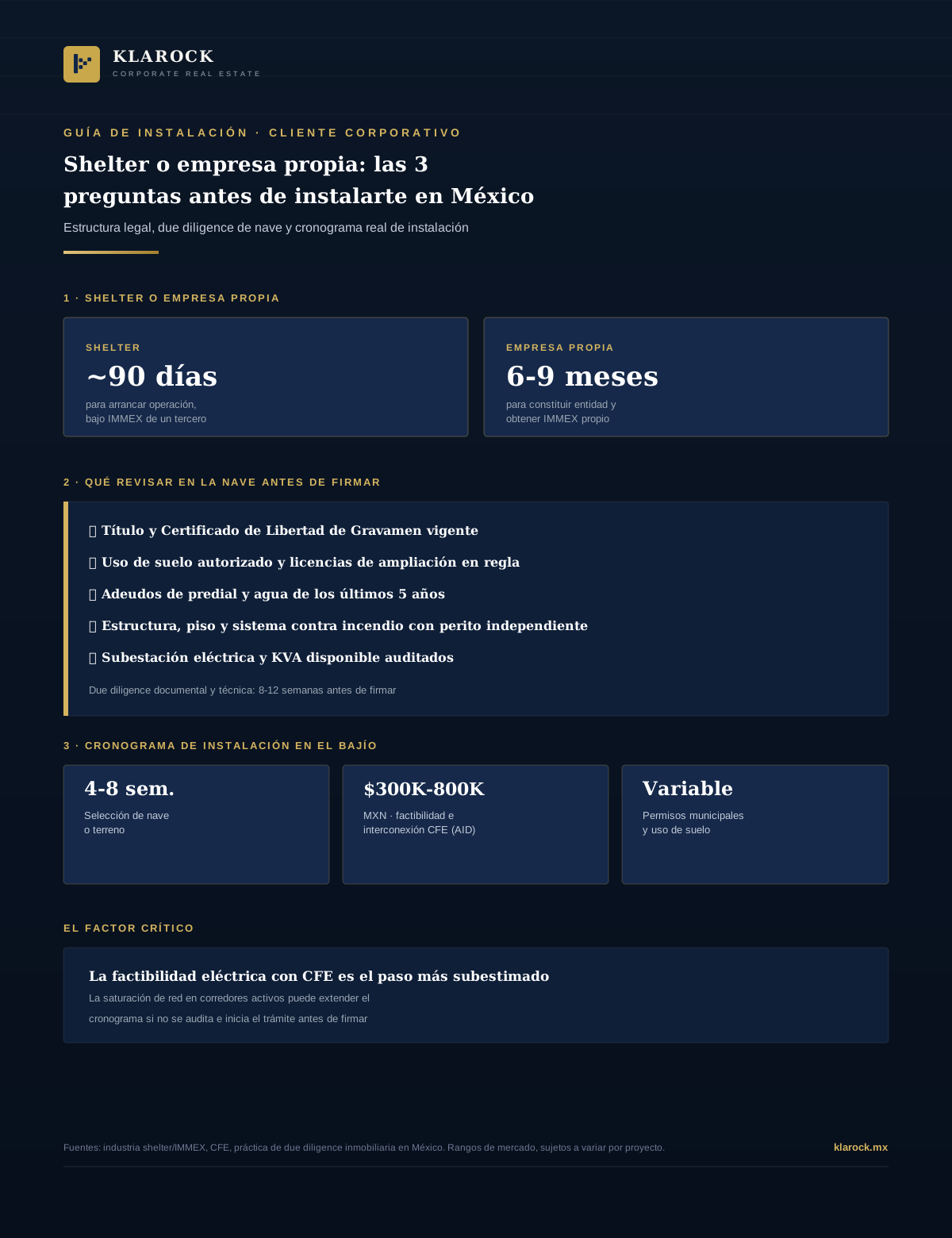
Every industrial expansion mandate in Mexico starts differently, but converges on the same three questions. The first is one of legal structure: shelter or own entity? The second is one of physical risk: what does the building have, and lack, before committing to a contract? The third is one of timing: how many months stand between the decision and the first production line running? Whoever answers these three with numbers instead of intuition is the one who earns the full mandate, not just the first meeting.
1. Shelter or Own Entity in Mexico?
- —The core difference is who the legal party is: under the shelter model, the operation runs under the IMMEX permit and legal personality of an established Mexican provider; the foreign company controls production, quality and supply chain, while the shelter provider is the registered employer and is responsible for payroll, compliance and customs. Under an own entity, the company sets up its own Mexican legal entity and files its own IMMEX registration.
- —Speed is the most-cited difference among industry operators: launching under a shelter can take on the order of 90 days, versus a range of 6 to 9 months to incorporate an own entity and independently obtain its own IMMEX registration.
- —A shelter also caps initial labor and customs risk: the shelter provider answers as employer of record in any labor dispute and as the party responsible for the accuracy of every customs entry, reducing the operation's exposure while the local team matures.
- —An own entity wins on long-term control: for operations planning to scale sustainably, build their own banking and tax relationship in Mexico, or eventually stop depending on a third party, an own entity is the natural path once the launch phase is behind them —many companies migrate from shelter to own entity between year 2 and year 4 of operation.
2. What to Check on a Building Before Signing
- —Title and registered liens: a public deed recorded with the Public Property Registry, a current Certificate of No Liens (Certificado de Libertad de Gravamen), verified ownership or corporate bylaws, and up-to-date powers of attorney —the foundation any contract is built on.
- —Land use and urban compliance: confirm the authorized land use matches the planned operation, that any expansion or modification to the building is permitted, and that no open administrative proceedings exist —the most common cause of post-signing disputes is buying or leasing without validating this first.
- —Outstanding obligations: a review of property tax and water payments for the past five years, and of any active lease agreements if the property already generates rent.
- —Technical infrastructure, with an independent engineer: structure, floor load capacity, fire suppression systems, and above all the electrical substation and available KVA —grid saturation in corridors like Nuevo León and Baja California can stall operational startup if it isn't audited before signing.
- —A real window to do it right: a serious documentary and technical due diligence takes 8 to 12 weeks when started ahead of signing —the difference between a protected operation and one exposed to avoidable risk.
3. How Long Does It Take to Set Up in the Bajío
- —Building or land selection: 4 to 8 weeks in an active corridor like Querétaro, Guanajuato or San Luis Potosí, depending on whether you're seeking already-built Class A+ space (faster) or a build-to-suit development (slower, but more tailored to the operation).
- —Electrical feasibility and interconnection with CFE: the distribution interconnection feasibility study (AID) and medium-voltage connection can cost between $300,000 and $800,000 MXN depending on distance to the substation, and timing depends directly on grid saturation in the area —the step most frequently underestimated in the schedule.
- —Municipal permits and land use: land-use permit and operating license, with timelines that vary by municipality but should be filed in parallel with the property search, not after signing it.
- —The shelter vs. own-entity gap becomes critical here: under shelter, the operation can be producing on the order of 90 days from the decision; under an own entity, the independent IMMEX registration adds 6 to 9 months to the schedule before even considering construction or fit-out of the building.
The Read for the Corporate Client
These three questions don't have abstract answers: the right legal structure depends on the operation's horizon, the right building depends on the technical audit done before signing, and the real timeline depends on variables —chiefly the electrical one— that rarely show up in the first proposal an operations director receives. A corporate client's trust isn't earned by promising the shortest path; it's earned by showing exactly where the bottlenecks are before they appear.
At Klarock we support the corporate client from the structure decision —shelter or own entity— through building due diligence and coordination of electrical feasibility with CFE, with a realistic timeline from day one.