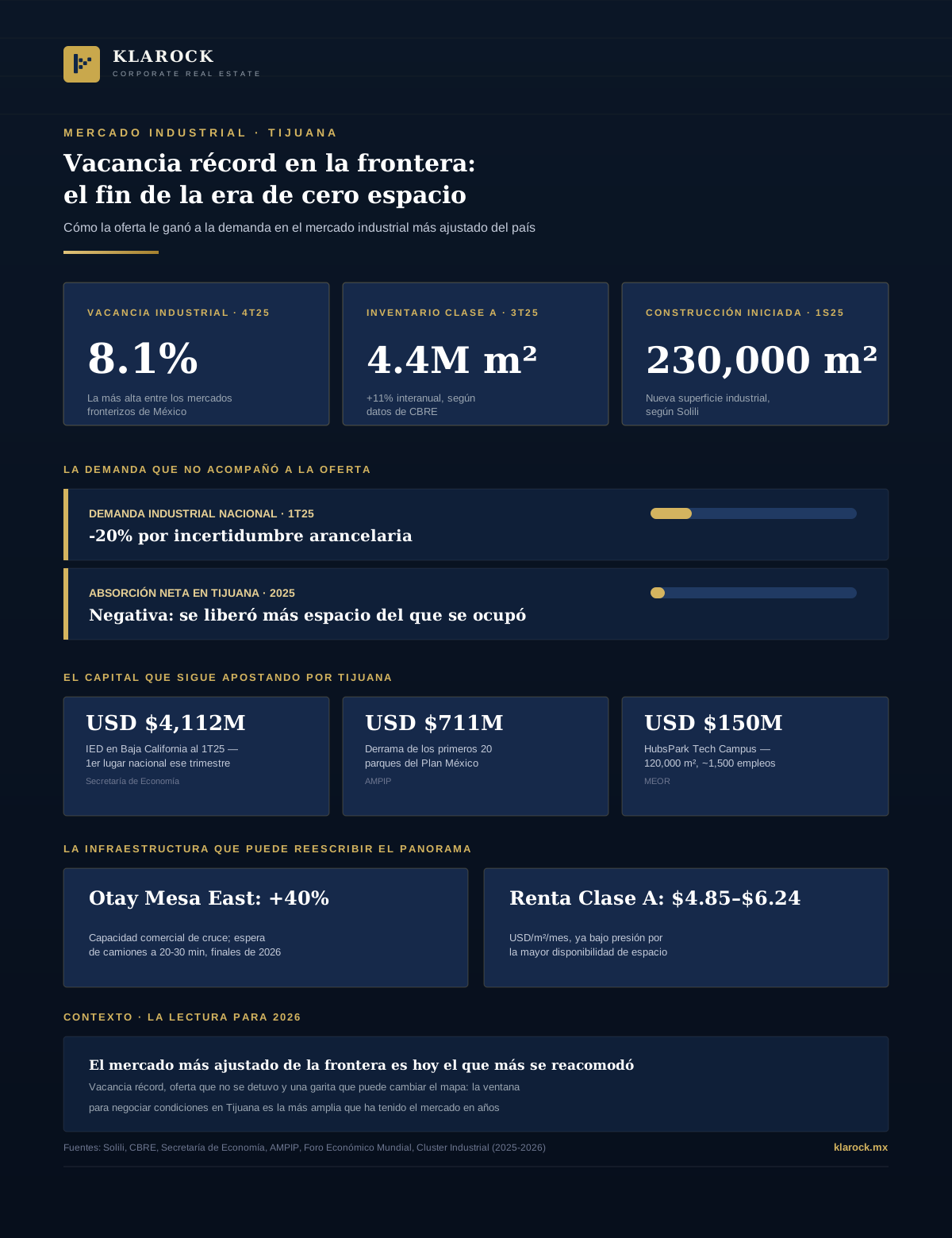
For nearly a decade, Tijuana was the textbook case of a border industrial market with no slack: vacancy hovering near zero, rents climbing steadily, and developers competing for every square meter that came available. That cycle is over. By the close of 2025, the city posted the highest industrial vacancy rate of any market along Mexico's northern border — and the cause isn't singular, but a combination of tariff uncertainty, supply that never stopped building, and demand that took a breather.
1. The End of Zero Vacancy
- —A historic high: Tijuana closed Q4 2025 with an industrial vacancy rate of 8.1%, the highest among Mexico's border markets, according to Solili's quarterly report.
- —A cycle reversed: just two or three years ago, the city was operating at essentially zero vacancy. Today, that same market is forcing developers and brokers to rethink how they place space.
- —An unwanted lead: among Mexico's major border markets, Tijuana has repriced the most over the past year, outpacing other industrial nodes along the northern border.
2. Demand Cools Under Tariff Uncertainty
- —A national contraction: tariff uncertainty shrank national industrial demand by roughly 20% during Q1 2025, per Solili, with border markets among the hardest hit.
- —Leasing activity halved: leasing volume in Tijuana ran at roughly half the pace recorded over the same period in 2024.
- —Negative net absorption: by Q3 2025, Solili reported that vacancy in Tijuana grew faster than occupancy did — the market gave up more space than it filled.
3. Supply Never Let Up
- —Construction kept moving: despite cooling demand, 230,000 sqm of new industrial space broke ground in Tijuana during the first half of 2025, according to Solili.
- —Class A inventory keeps growing: Class A industrial inventory reached 4.4 million sqm by the close of Q3 2025, an 11% year-over-year increase, per CBRE data.
- —Pressure on rents: asking rents for Class A space run between US$4.85 and $6.24 per sqm per month, based on 2025 market comps — a range already starting to feel the weight of greater availability.
4. The Capital Still Betting on Tijuana
- —Foreign direct investment: Baja California accumulated US$4.112 billion in FDI through Q1 2025, ranking first nationally that quarter, per Secretaría de Economía figures cited by regional press.
- —Plan México at the border: AMPIP delivered the first 20 industrial parks toward its national goal of 100 under Plan México, representing US$711 million in economic impact nationwide, with development also reaching Baja California.
- —Anchor projects: developer MEOR announced a US$150 million investment in HubsPark Tech Campus (120,000 sqm, with roughly 1,500 jobs projected), while Grupo Frisa opened Banderas Tech Park with an US$11.16 million investment across 11,200 sqm.
- —Sectors holding up demand: medical devices, electronics, aerospace, and automotive remain the region's leading occupancy drivers, per sector commentary from CBRE and Cushman & Wakefield.
5. The Infrastructure That Could Rewrite the Picture
- —Otay Mesa East: the new border crossing, with a phased opening targeted for late 2026, would raise commercial crossing capacity by roughly 40% and cut truck wait times to a 20-to-30-minute range.
- —The other bottleneck: a July 2025 World Economic Forum report flags mounting water-energy stress in Baja California, with 2025 ranking among the region's driest years since 1950.
- —The read for investors: higher vacancy, new border infrastructure, and tightening resource constraints together redraw the decision map for anyone looking to position in Tijuana through 2026.
At Klarock, we track these indicators closely to advise every expansion, relocation, or investment decision in Tijuana and across Mexico's other border corridors with real data.