Retail · 2026-08-06
Behind the promise of delivery in under 30 minutes lies a deep logistics shift redrawing the commercial map of Mexico's biggest cities: dark stores.
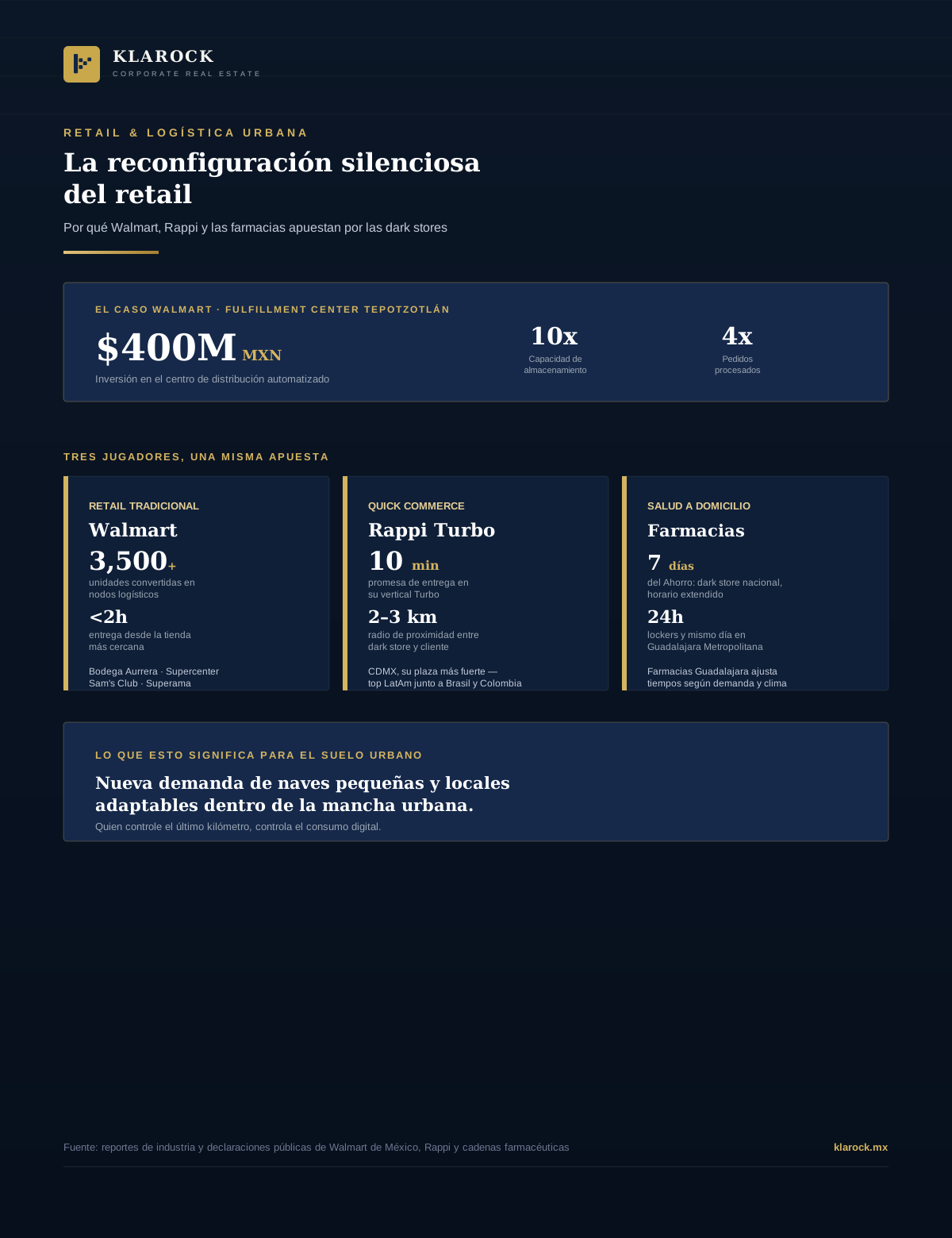
Behind the promise of getting groceries, medicine, or dinner delivered in under 30 minutes lies a deep logistics transformation redrawing the commercial map of Mexico's biggest cities. Traditional retailers, delivery platforms, and pharmacy chains are converging on the same strategy: installing dark stores — delivery warehouses laid out like a store but closed to the public — inside the metro areas where digital-consumer density is highest.
The growth of ultra-fast delivery in Mexico is directly tied to the urban concentration of cities like Mexico City, Guadalajara, and Monterrey. Consumer density, combined with dark stores and micro-distribution hubs, makes it possible to fulfill fast-delivery promises across product categories profitably, and urban lifestyles — less free time, higher digital adoption — reinforce that demand.
Heading into 2026, industry specialists agree the challenge is no longer just delivery speed, but operational efficiency, route optimization, and using advanced analytics to forecast demand — plus using data to decide exactly where to place each dark store.
Walmart de México y Centroamérica is perhaps the most visible case of this shift. The chain has converted much of its 3,500+ stores — Bodega Aurrera, Walmart Supercenter, Sam's Club, and Superama — into logistics nodes that dispatch online orders from the store closest to the customer, cutting delivery times in some cases to under two hours. This runs on micro-fulfillment centers installed inside the stores themselves.
The most recent leap happened in Tepotzotlán, State of Mexico, where the company opened an automated distribution center dedicated exclusively to e-commerce. According to Cristian Barrientos Pozo, president and CEO of Walmart de México, the 400 million peso investment in that Fulfillment Center Mega Park will boost storage capacity tenfold and quadruple the number of orders processed. The company no longer thinks of its operation as a simple store network supplied by distribution centers, but as infrastructure designed to fulfill unit-level orders, in real time, at national scale — a model reminiscent of the fulfillment system Amazon built over a decade ago, though starting from an existing network of physical stores.
Rappi pioneered the pure dark-store model in Mexico with Rappi Turbo, its ten-minute delivery vertical. The company has reported dozens of warehouses operating across the country, with Mexico City as its strongest market, and works with a proximity logic of just two to three kilometers between each store and its customers to sustain minimum delivery times. Industry reports place Mexico among the Latin American markets with the most dark stores within the Rappi Turbo Fresh ecosystem, alongside Brazil and Colombia.
This model has also served as a template for traditional retailers looking to go digital without building their own fleet: major brands already operate under this model, and traditional retailers wanting to digitize without losing speed are adopting it too, in cities like Mexico City, Santiago, and Bogotá.
The pharmaceutical sector hasn't been left behind. Farmacias del Ahorro — the country's largest pharmacy chain — runs its own dark-store scheme to fulfill online orders nationwide, with deliveries seven days a week during extended hours. Farmacias Guadalajara, for its part, has strengthened home delivery across the Guadalajara metro area, with 24-hour locker pickup and same-day dispatch within the urban zone, adjusting times when demand or weather requires it.
For pharmacies, the appeal of the model goes beyond convenience: recurring-use medications, personal care products, and low-volume items are ideal for compact warehouses close to the consumer — a pattern the global dark-store market itself identifies as the most profitable to operate.
The expansion isn't friction-free. Rappi, for instance, has flagged difficulty finding suitable warehouses in high-density areas when expanding into new cities. Industry-wide, the most cited challenges include deciding which products justify ultra-fast delivery, building hybrid models between traditional retail and quick commerce, relying on last-mile logistics partnerships, and clearly communicating to the consumer the real value of paying for speed.
The multiplication of dark stores across metro areas isn't an isolated logistics phenomenon: it's reshaping how commercial land gets used, generating new demand for small industrial buildings and adaptable retail spaces within the urban fabric, and pushing traditional retailers to operate simultaneously as stores and as distribution centers. Walmart, Rappi, and the major pharmacy chains share the same bet: whoever controls the last mile within the city will control a large share of digital consumption in the years ahead.
At Klarock, we identify and market exactly that kind of asset — small, well-located buildings and retail spaces within the urban footprint — that are now competing to become the next dark store.
Reach out and a managing partner will contact you within 24 business hours.
Contact a Managing Partner